
All About Home Addition Costs

What a Home Addition Really Costs — and Whether It's Worth It
A home addition is one of the most effective ways to gain space without the stress of selling your home and moving. Here's a quick snapshot of what you need to know:
| Addition Type | Typical Cost Range | Average ROI |
|---|---|---|
| Bump-out / Room Addition | $30,000 – $75,000 | Up to 93% (kitchen) |
| Sunroom | $15,000 – $30,000 | 50–75% |
| Garage Conversion | $6,000 – $30,000 | Up to 80% |
| Attic Conversion | ~$40,000 | ~56% |
| Basement Finishing | $2,800 – $34,000 | ~70% |
| Second-Story Addition | $80,000 – $600,000 | 65–75% |
| Detached ADU / DADU | $100,000+ | Varies |
| Dormer Addition | $12,000 – $70,000 | Improves resale value |
Whether you're a Long Island homeowner with a cramped attic, a growing family that needs another bedroom, or someone who simply loves your neighborhood but hates your layout — adding on to your home almost always makes more financial sense than buying new. In 2026, with mortgage rates still elevated near 7%, that calculation is even more compelling.
That said, costs vary enormously depending on the type of addition, your local building requirements, and the complexity of tying new construction into your existing structure. A small bump-out and a full second-story addition are both "home additions" — but they live in completely different budget universes.
This guide breaks it all down clearly, so you can make a confident decision.
I'm Jacolyn Gleason, a Senior Vice President at 5W Public Relations with deep experience navigating complex consumer and construction-industry communications, including projects centered on home addition trends and the remodeling market. My background in translating technical subject matter for everyday audiences is exactly what I bring to this guide, so keep reading for a complete, no-fluff breakdown of everything Long Island homeowners need to know before breaking ground.

Related content about home addition:
Understanding the Cost of a Home Addition by Type
When planning a home addition, the first question we always hear is: "How much is this actually going to cost me?" The truth is that there is no single "per square foot" price that applies to every project. While basic framing and drywall might run $150 to $400 per square foot depending on complexity, the final price tag depends heavily on what is going inside those walls.
For instance, a dry 12x12 bedroom addition requires minimal plumbing and simple electrical routing. On the other hand, a kitchen expansion or a new primary bathroom requires extensive plumbing lines, high-end fixtures, tile work, and specialized ventilation. This is why we price additions based on their "program"—the specific functional requirements of the space—rather than just the raw footprint.
To help you visualize your options and how they stack up, we have compiled a comparison of the most common ways to expand your home on Long Island:
| Addition Type | Average Cost Range | Footprint Impact | Major Cost Drivers |
|---|---|---|---|
| Bump-Out | $15,000 – $50,000 | Minimal (extends 2–10 ft) | Cantilever framing, exterior tie-ins |
| Sunroom | $15,000 – $30,000 | Moderate (ground level) | Glass quality, HVAC integration |
| Second-Story Addition | $80,000 – $600,000 | None (builds upward) | Foundation reinforcement, roof removal, stairs |
| Detached ADU (DADU) | $100,000+ | High (requires yard space) | Separate utility connections, full foundation |
By taking a closer look at each category, you can better align your physical space requirements with your financial comfort zone.
Ground-Level Extensions and Bump-Outs
If your home has a solid foundation but a cramped interior layout, a ground-level extension or a micro-addition known as a "bump-out" might be your best bet. A bump-out is a small-scale room addition that extends a few feet outward from the existing side of your house. Because they often use cantilever construction—meaning they hang off the existing floor joists without requiring a brand-new foundation—bump-outs are highly cost-effective, typically costing 15% to 30% less than a full conventional foundation addition.
A common application is a kitchen bump-out. If you are struggling to fit an island or a dining nook, adding just 50 square feet can completely transform the flow of your kitchen. For detailed guidance on preparing for this specific project, read our resource on Home Addition Planning: Your Complete Kitchen Upgrade.
For larger room additions, such as adding a first-floor family room or an extra bedroom, you will need to pour a conventional concrete foundation. While this adds to the upfront cost, it provides a permanent, structural extension of your home's main living area that seamlessly integrates with your existing floor plan.
Second-Story Additions and Dormers
For homeowners on tight Long Island lots where zoning setbacks or small yards prevent building outward, building up is the ultimate solution. A second-story addition can double your home's square footage without sacrificing a single blade of grass in your backyard.
However, building up requires a highly technical approach. Before any framing begins, a structural engineer must assess whether your existing foundation and first-floor walls can support the immense weight of a new story. If reinforcement is required, it can drive up the total investment. Additionally, because the existing roof must be completely removed, families must plan to live elsewhere during the structural phase of construction. To get a detailed understanding of the financial commitment involved, you can read our breakdown of Second Story Addition Cost.
If a full second story feels like overkill for your budget, a dormer addition is an incredible alternative. Popularized across Nassau County and Suffolk County ranch-style homes, dormers project vertically from a sloping roof, creating extra headroom, usable floor space, and plenty of natural light in an otherwise cramped attic.
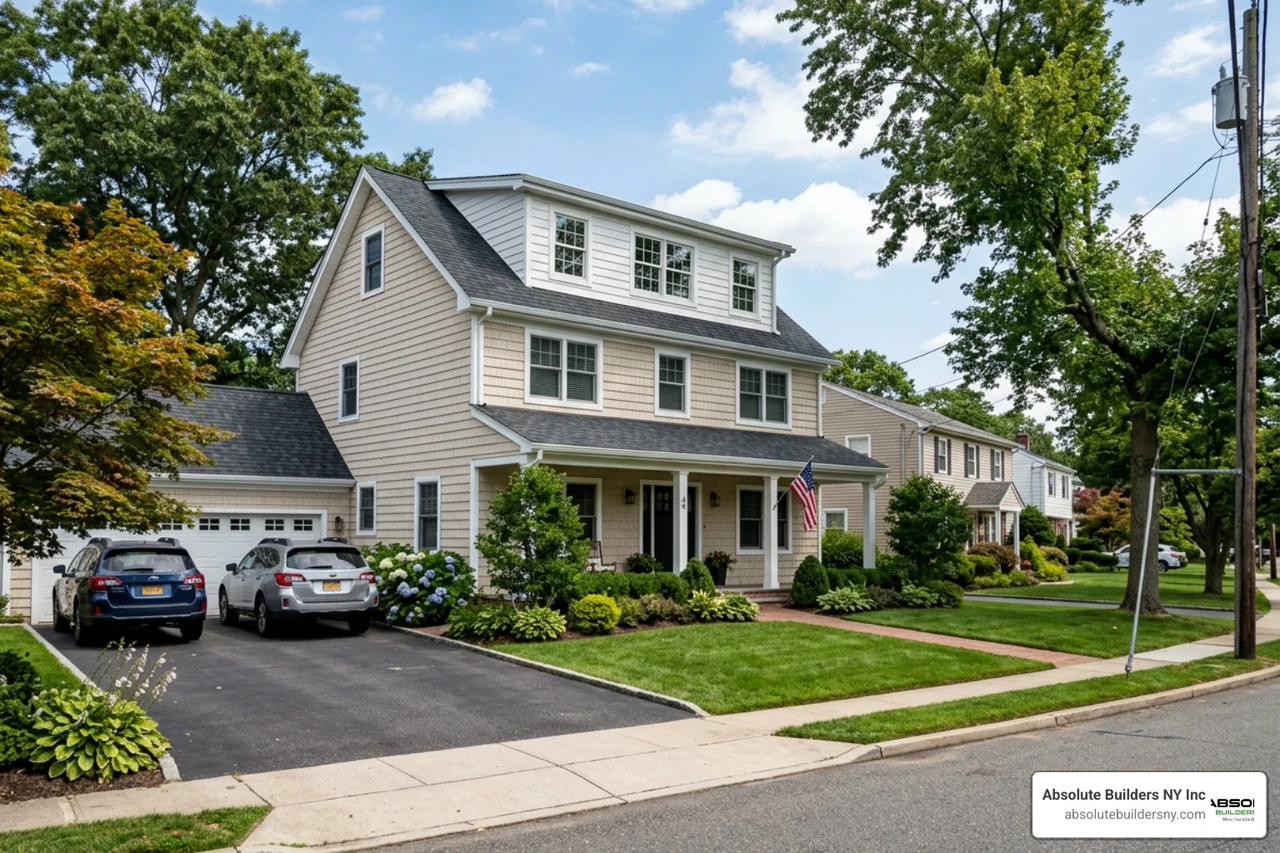
Whether you want to add a home office, a cozy bedroom, or a second-floor laundry room, dormers offer high architectural value at a fraction of the cost of a full second story. To explore how these structures work and how they can elevate your property's curb appeal, check out What Are Dormers: A Guide to Adding Space, Value and Functionality.
Accessory Dwelling Units (ADUs) and Sunrooms
As multi-generational living becomes the norm in 2026, many families are looking for ways to accommodate aging parents or adult children while maintaining personal privacy. This has driven a massive surge in the popularity of Accessory Dwelling Units (ADUs) and Detached ADUs (DADUs), sometimes referred to as backyard cottages or "granny flats."
A tiny house or DADU typically starts around $100,000, depending on utility hookups, framing, and interior finishes. While it is a significant investment, an ADU serves as a fully functional, independent living space complete with its own kitchen, bathroom, and entrance. If you are interested in exploring this path to accommodate loved ones, you can learn more about the design and planning process in our guide to In-Law Suite Addition.
For those who want to enjoy the beauty of the outdoors without dealing with Long Island's seasonal bugs and unpredictable weather, a sunroom is a fantastic addition. A professionally installed, year-round sunroom averages around $30,000. However, keep in mind that unless a sunroom is fully integrated into your home's central HVAC system and meets strict local energy codes, building inspectors may not classify it as permanent, year-round living space.
Conversions vs. New Builds: Maximizing Existing Footprints
Before you commit to pouring concrete or tearing off your roof, it is always wise to look within. Converting an underutilized, existing space like an attic, basement, or garage is almost always more affordable than building a brand-new structural addition. Because the foundation, exterior walls, and roof are already standing, you save thousands of dollars on raw structural materials.
However, conversions come with their own unique set of challenges. You are forced to work within the physical constraints of the existing structure. If your basement has low overhead clearance, or if your attic is framed with web-like roof trusses rather than open rafters, converting those spaces may require expensive structural modifications to meet local building codes.
Attic and Basement Conversions
Finishing a basement or converting an attic are two of the most popular ways to gain square footage on a budget. Nationally, finishing a full attic space averages about $40,000, while finishing a basement typically costs about half of that, ranging from $2,800 to $34,000 depending on the size and moisture-mitigation needs.
When converting these spaces, safety and code compliance are paramount. For basement bedrooms, local building codes mandate the installation of egress windows or a direct walkout to the backyard so occupants can escape safely in an emergency. In the attic, at least half of the finished ceiling must reach a height of seven feet, and the room must be accessible via a permanent, code-compliant staircase rather than a pull-down ladder.

If you are ready to unlock the hidden potential beneath your feet, read our complete guide on Basement Finishing and Beyond: Maximizing Space and Value in Your Home.
Garage Conversions
An attached garage is prime real estate for a home addition conversion. Averaging between $6,000 and $26,000, turning a garage into a family room, home gym, or a dedicated Mother In Law Suite is highly cost-effective because the structural shell is already complete.
However, garages are built to house cars, not people. To make the space livable, you must invest in proper insulation, finish the concrete floor with comfortable flooring, and integrate the space into your home's HVAC system (often using a highly efficient ductless mini-split system). If you plan to add a bathroom or a small kitchenette to create a true self-contained suite, routing new plumbing lines through the existing concrete slab will be a major cost factor. To understand the benefits and layout options for these projects, read What Is a Mother In Law Suite: The Benefits, Options and Expectations.
Key Factors That Influence Your Total Investment
When budgeting for a home addition, it is easy to get caught up in the cost of lumber and drywall. However, the final price tag of your project is shaped by three main variables:
- Material Selections: The gap between standard builder-grade materials and luxury finishes is massive. Opting for custom cabinetry, natural stone countertops, or high-performance architectural windows can easily double your interior finishing costs.
- Labor Rates: Construction labor rates on Long Island are among the highest in the country. Specialized trades—such as licensed plumbers and electricians—command premium rates, which is why additions with complex mechanical requirements cost significantly more.
- Site Conditions: Unforeseen issues beneath the surface can quickly impact your budget. If excavation reveals poor soil quality, high water tables, or buried boulders, your foundation work will require additional engineering and labor to complete safely.
How to Choose the Right Home Addition for Your Family
The best addition is one that solves your current spatial headaches while adapting to your family's future needs. Before you start drawing up plans, ask yourself a few critical questions:
- Will the number of residents in our home change over the next five to ten years?
- Are we planning for aging-in-place, or do we need spaces that can transition from playrooms to teen hangouts and eventual home offices?
- How will this project affect our long-term financial situation?
To help you navigate these big decisions and map out your goals, we have put together a comprehensive Home Addition Plans Guide 2026. This guide will help you define the exact problems you are trying to solve so you don't end up building space you won't use.
Return on Investment (ROI) and Resale Value
While you are building an addition to improve your daily life, it is comforting to know that a well-executed project is a powerful investment in your home's equity. However, not all additions yield the same return at resale.
Historically, kitchen expansions and bump-outs recoup the highest percentage of their cost—often up to 93%—because the kitchen remains the emotional and functional heart of the home. Garage conversions also perform exceptionally well, recovering up to 80% of their cost. Primary suite additions and second-story builds typically recoup between 50% and 75% of their initial investment.
To maximize your ROI, always keep your neighborhood standards in mind. Overbuilding—such as adding a massive five-bedroom suite to a modest ranch in a starter-home neighborhood—can make your home difficult to sell later. Buyers expect homes in a specific area to fit within a certain price and utility bracket, so design your addition to elevate, rather than completely outpace, your surrounding neighborhood.
Navigating Permits, Zoning, and Construction Timelines
One of the most common pitfalls for eager homeowners is underestimating the administrative work required before the first hammer swings. On Long Island, you cannot simply decide to build and start digging the next Monday. Legally expanding your home's footprint or height requires strict adherence to local town ordinances and safety codes.
Long Island Building Codes and Permit Processes
Whether you live in Nassau County or Suffolk County, every town - from Hempstead and Oyster Bay to Babylon and Huntington - has its own local building department with unique zoning bylaws and setback requirements. Setbacks dictate exactly how close your addition can sit to your front, side, and rear property lines.
If your proposed design encroaches on these boundaries, you will need to apply for a zoning variance. This process requires presenting your plans to a local zoning board and notifying your neighbors, which can add months to your pre-construction timeline.
In addition to local town requirements, residential construction in New York must comply with applicable state code standards. For general statewide code context, homeowners can review the New York State Uniform Fire Prevention and Building Code, though your local building department remains the authority for your specific permit and inspection requirements.
Furthermore, if your home relies on an individual well and septic system (common in many Suffolk County communities), you must obtain approval from the local department of health to ensure your new addition does not overload your system's capacity. To ensure you are fully prepared for these regional requirements, it can be helpful to study local Nassau County building guidelines and consult with a design-build team that has strong working relationships with town inspectors.
What to Expect During the Construction Timeline
Building a home addition is a major undertaking that typically spans several months. While a simple screened porch or a straightforward garage conversion might wrap up in 6 to 8 weeks, a complex second-story build or a multi-room ground-level extension routinely takes 3 to 8 months from groundbreaking to final walkthrough.
Here is a general breakdown of the phases you will experience:
- Phase 1: Planning and Permitting (4 to 10 weeks): Architectural drawings are finalized, structural engineering is completed, and permit applications are submitted to your local town hall.
- Phase 2: Excavation and Foundation (2 to 4 weeks): For ground-level builds, the site is cleared, footings are poured, and foundation walls are erected.
- Phase 3: Framing and Exterior Shell (3 to 6 weeks): The "bones" of the addition are built, roof rafters are installed, and the structure is wrapped to protect it from the elements. Siding, roofing, and windows are installed.
- Phase 4: Rough-Ins (2 to 4 weeks): Plumbers, electricians, and HVAC technicians route pipes, wires, and ductwork through the open framing.
- Phase 5: Insulation and Drywall (2 to 3 weeks): Inspections are passed, insulation is installed, and drywall is hung, taped, and mudded.
- Phase 6: Interior Finishes (4 to 8 weeks): Flooring, trim, cabinetry, paint, and light fixtures are installed.
- Phase 7: Final Inspections and Walkthrough (1 to 2 weeks): Local town inspectors sign off on the work, and you receive your official Certificate of Occupancy (CO).
Financing Options and Budgeting Strategies
A successful renovation relies as much on smart financial planning as it does on quality craftsmanship. Because unexpected structural surprises can hide behind old plaster or beneath your yard's soil, we always advise setting aside a dedicated contingency reserve of 15% to 20% of your total estimated project cost. This financial buffer ensures that if your contractor discovers outdated wiring or structural issues, your project won't grind to a halt.
Should You Hire a Professional or Attempt a DIY Home Addition?
With the rise of online tutorials, many handy homeowners wonder if they can tackle a home addition as a do-it-yourself project. While DIY projects are great for interior cosmetic updates, structural additions are a completely different animal.
Building an addition requires a deep understanding of structural load paths, foundation engineering, electrical codes, and complex roof tie-ins. Attempting to DIY a major structural build can lead to catastrophic safety hazards, structural sagging, and water leaks that void your home insurance policy. Furthermore, most Long Island municipalities require a licensed and insured contractor to pull the necessary building permits.
If you are highly skilled and want to save on labor, a smart compromise is to hire a professional design-build firm to handle the structural shell (foundation, framing, roofing, and window installation) and then take over the interior finishes—such as painting, tiling, and installing trim—yourself. For a realistic look at what goes into drafting and executing plans, check out our DIY Home Addition Plans Guide.
Smart Financing Paths for Every Budget
Unless you have significant cash reserves, you will likely need to secure financing to fund your project. Fortunately, homeowners have several excellent options to choose from:
- Home Equity Line of Credit (HELOC): A HELOC allows you to borrow against the equity you have built up in your home. Because it functions like a credit card with a revolving limit, it is perfect for phased additions where you pay for work as it is completed.
- Construction Loans: If you are planning a massive, high-value project like a full second-story addition, a construction loan provides short-term funding to cover building costs, which then converts into a traditional mortgage once the project receives its Certificate of Occupancy.
- Cash-Out Refinance: This option replaces your existing mortgage with a new, larger loan, allowing you to take the difference in cash to fund your construction.
Before you secure your funding, it is incredibly helpful to look at sample layouts and floor plans to understand what is physically possible. To get started without any upfront design fees, you can explore our resources and download Free Home Addition Plans.
Frequently Asked Questions About Home Additions
What is the cheapest type of home addition?
The most budget-friendly structural addition is a bump-out. Because they extend only a few feet and can often be cantilevered off your existing floor joists, they avoid the high cost of pouring a new concrete foundation. If you are looking for a simple, non-structural space to enjoy during the warmer months, screened porches and three-season sunrooms are also highly cost-effective options.
Is it cheaper to build up or build out?
Generally, building out (a ground-level addition) is more cost-effective than building up (adding a second story). Building up requires removing your existing roof, reinforcing the first-floor walls and foundation to support the extra weight, and sacrificing existing first-floor living space to install a code-compliant staircase. However, if your property has tight zoning setbacks or a small yard, building up may be your only viable option.
Do I need a permit for a home addition on Long Island?
Yes. Virtually all structural modifications, footprint expansions, and height increases require building permits in both Nassau and Suffolk counties. Building without a permit can result in severe municipal fines, complicate your ability to sell your home in the future, and may even prevent your home insurance provider from covering future damage claims. Always work with a licensed contractor who handles the permit application process with your local town building department.
Conclusion
Expanding your home is a major milestone that requires a careful balance of architectural vision, structural engineering, and smart budgeting. Whether you are looking to install a beautiful new dormer addition to bring light into your attic, remodel your kitchens & bathrooms for improved daily flow, or build a spacious multi-generational suite, the key to a successful project is working with a partner you can trust.
At Absolute Builders NY Inc, we specialize in transforming architectural dreams into beautifully crafted, structurally sound spaces. Based right here on Long Island, we pride ourselves on precision craftsmanship and dedicated partnership, guiding our clients through every step of the planning, permitting, and construction process.
Ready to stop feeling cramped and start falling in love with your home all over again? Visit our Absolute Builders NY Inc Home Addition Service Page today to schedule your free consultation, and let's build something beautiful together.