
How Much Does a Second Story Addition Actually Cost
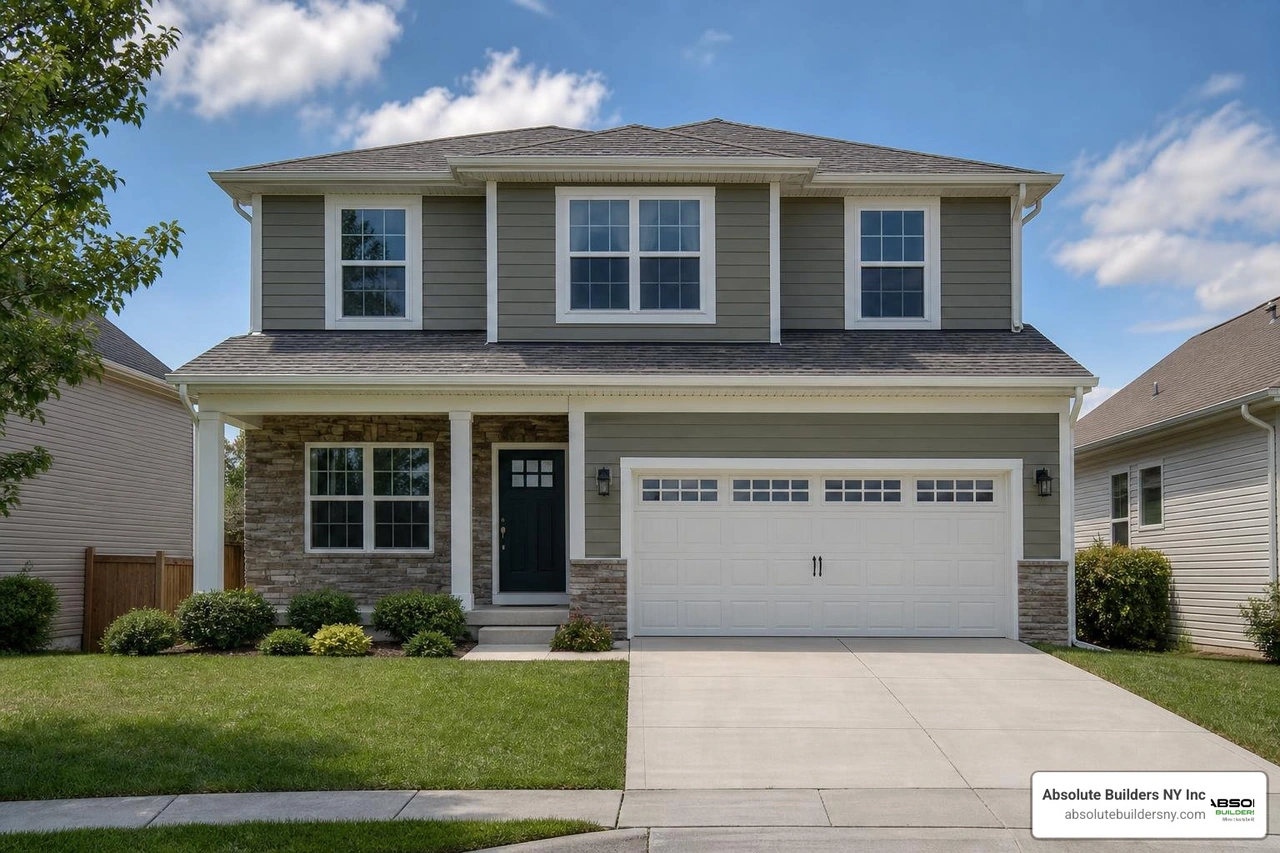
Is a Second Story Addition Worth the Cost in 2026?
If you're trying to get a quick handle on second story addition cost before diving into the details, here's what most Long Island homeowners are looking at in 2026:
| Project Type | Typical Cost Range |
|---|---|
| Partial second story (e.g., dormer or suite) | $80,000 – $250,000 |
| Full second story addition | $150,000 – $600,000+ |
| Cost per square foot | $200 – $500+ |
| National average total cost | ~$175,000 |
Quick answer: Most homeowners spend between $150,000 and $300,000 for a full second story addition. Costs vary widely based on size, location, structural needs, and finish level.
Your home felt just right — until it didn't. Maybe the kids need their own rooms. Maybe you need a dedicated home office. Maybe the attic just isn't cutting it anymore. Whatever the reason, you're running out of space without wanting to give up your yard, your neighborhood, or your school district.
Building up is one of the most powerful ways to solve that problem. But it's also one of the most complex and expensive home projects you can take on. A second story addition isn't just adding square footage — it touches your foundation, your roof, your HVAC, your electrical panel, and your budget in ways that catch a lot of homeowners off guard.
That's why getting a realistic cost picture before you fall in love with floor plans is so important.
I'm Jacolyn Gleason, a Senior Vice President at 5W Public Relations with extensive experience communicating complex home improvement and construction topics — including the real-world factors that drive second story addition cost — in ways that help homeowners make confident, informed decisions. In the sections below, we'll break down exactly what you can expect to spend, what drives costs up, and how to plan smartly for a vertical addition on Long Island.
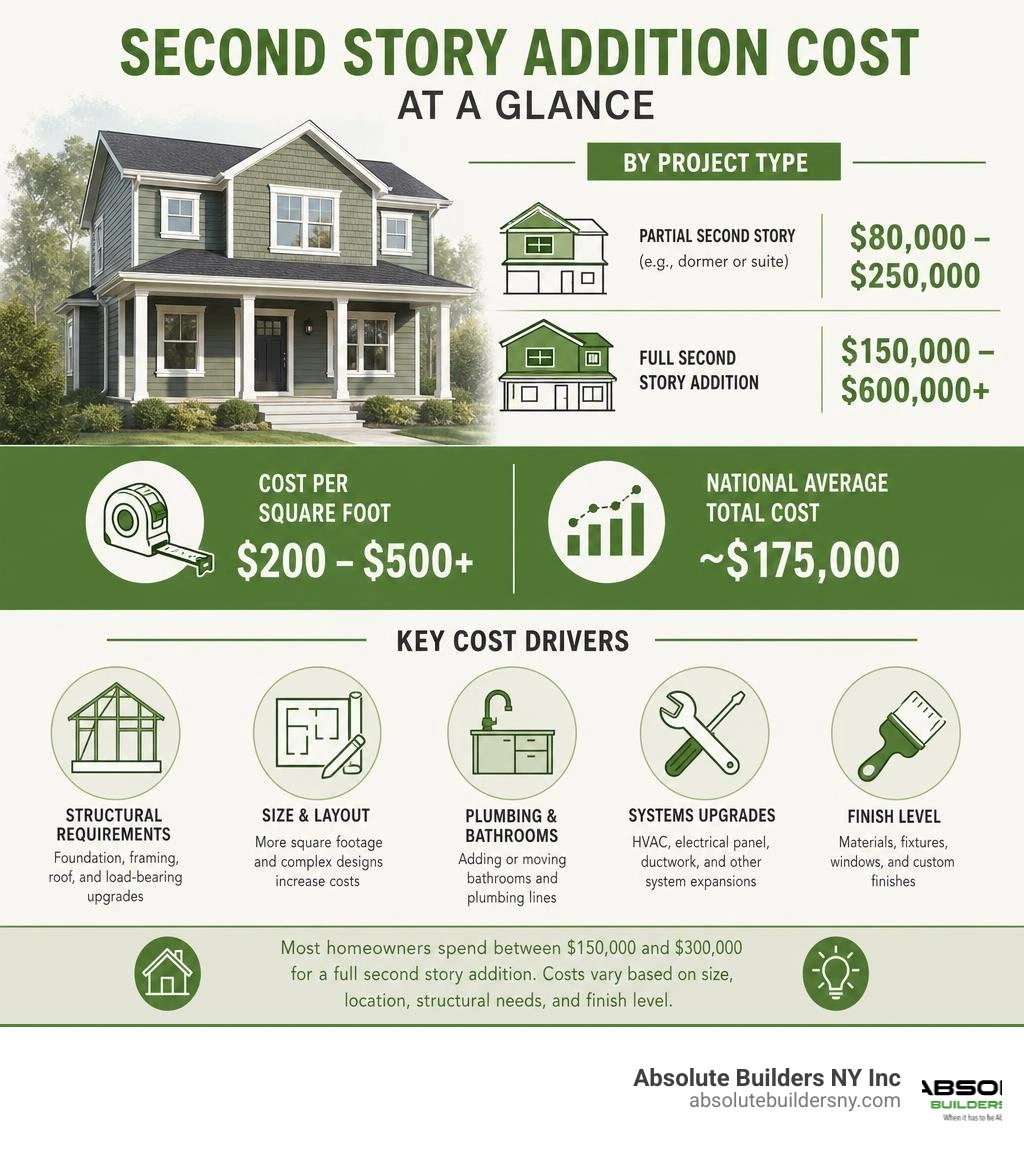
Second story addition cost word guide:
Understanding the Second Story Addition Cost in 2026
When we talk about adding a second story to a home on Long Island—whether you are in West Babylon, Huntington, or across Nassau and Suffolk County—we are discussing a highly customized, structurally intense project. Because of our regional labor rates, strict building codes, and municipal permitting structures, realistic costs for a high-quality Home Addition typically range from $300 to $500+ per square foot.
While national averages sit closer to $175,000, a complete vertical expansion in our area usually lands between $200,000 and $600,000+.
To help you visualize where your project might fit, here is a breakdown of average costs by project type and size:
| Project Scope | Average Square Footage | Estimated Cost Range (Long Island) |
|---|---|---|
| Partial Dormer / Small Suite | 300 – 500 sq. ft. | $90,000 – $180,000 |
| Large Partial Addition (2 Beds, 1 Bath) | 600 – 800 sq. ft. | $180,000 – $320,000 |
| Full Second Story (Ranch-to-Colonial) | 1,000 – 1,500 sq. ft. | $300,000 – $600,000+ |
| Luxury Full Addition (Premium Finishes) | 1,500+ sq. ft. | $600,000 – $1,000,000+ |
Every vertical addition is unique. Unlike a ground-level build, you cannot simply pour a slab and start framing. We have to peel off your existing roof, reinforce your first-floor ceiling joists, and ensure the entire structure can carry the new load. These fixed structural costs mean that even a smaller "partial" addition carries a higher baseline cost than most homeowners expect.
Estimating Your Second Story Addition Cost Per Square Foot
Why does the cost per square foot range so wildly from $200 to over $500? It comes down to three main variables: design complexity, material quality, and labor.
- Design Complexity: A simple rectangular "box" addition is the most cost-effective shape to frame and build. If your architectural plans call for complex rooflines, bay windows, or cantilevered sections, the engineering and framing labor costs will rise quickly.
- Material Quality: Standard vinyl siding and asphalt shingles keep costs on the lower end of the spectrum. Upgrading to fiber-cement siding, premium cedar shakes, or metal roofing will push your exterior costs up. Inside, the differences between standard builder-grade finishes and luxury custom tile, hardwood, and cabinetry can swing your final budget by tens of thousands of dollars.
- Labor Rates: On Long Island, skilled labor is in high demand. Licensed, insured, and experienced framing, plumbing, and electrical crews command a premium, but they are essential for keeping your project safe and code-compliant.
To get a better sense of how these variables interact with your specific goals, you can play around with a Second Story Addition Cost Calculator: ROI & Budget Planning Tool | Ultimate Calculators to model different design and finish levels.
Hidden Factors That Drive Up Your Second Story Addition Cost
When budgeting, it is easy to focus entirely on the visible elements: the new bedrooms, the beautiful bathroom tile, and the new siding. However, the "hidden" or soft costs of a vertical addition often catch homeowners off guard. Here are the major factors you must account for in your contingency budget:
- Temporary Housing ($15,000 – $35,000): You cannot live in a house that does not have a roof. During the demolition, framing, and rough-in phases (typically 3 to 5 months), you will need to rent a local home or stay elsewhere.
- HVAC System Upgrades ($8,000 – $25,000): Your existing furnace or boiler was sized specifically for your first floor. It almost certainly lacks the capacity (BTUs) to heat and cool an additional 1,000 square feet. You will either need to install a secondary system, upgrade your main unit and extend ductwork, or install a highly efficient multi-zone ductless mini-split system.
- Electrical Panel Upgrades ($3,000 – $6,500): Many older Long Island homes still run on 100-amp electrical service. Adding a second story with multiple bedrooms, bathrooms, and modern climate control will require upgrading your main panel to 200-amp service.
- Plumbing Tie-Ins ($5,000 – $15,000): Running new supply and drain lines up through existing first-floor walls requires surgical demolition and careful routing to align with your home’s main sewer or septic connection.
- Architectural, Engineering, and Permit Fees ($10,000 – $30,000): Before a single hammer swings, you need fully stamped architectural blueprints and structural engineering calculations to submit to your local town hall (such as the Town of Babylon, Huntington, or Oyster Bay) for building permits.
Structural and Foundation Requirements for Building Up

The absolute first rule of vertical construction is simple: You must verify what is holding you up.
Before we can build your dream second floor, we have to make sure your existing home can actually support it. A home’s foundation and first-floor framing were designed to hold the weight of a roof, not an entire second house. Adding a second story essentially doubles the "dead load" (the weight of the structure itself) and adds significant "live load" (the weight of people, furniture, and belongings).
To ensure your home is a safe candidate, we work closely with a licensed structural engineer. The engineer will perform a thorough assessment, which includes:
- Checking the Footings: Digging test holes next to your foundation to verify the depth and thickness of your concrete footings.
- Evaluating the Soil: Ensuring the ground beneath your home is stable enough to handle the increased weight without settling unevenly.
- Inspecting First-Floor Framing: Checking if your existing wall studs are 2x4s or 2x6s, and evaluating the spacing of your ceiling joists.
If your home was built before the 1970s, or if it sits on a slab foundation, it will likely require some structural reinforcement. This might involve pouring concrete underpinning to strengthen the existing foundation, installing steel columns or helical piers, or adding plywood shear walls to handle lateral wind loads.
Skipping this step is not an option. Investing in a proper engineering assessment up front prevents catastrophic structural settling down the road. For a deeper look at this process, check out our guide on Adding a Second Story to Your House.
Building Up vs. Building Out: Cost and Value Comparison

When you need more space, you face a classic architectural crossroad: Do you build up (a second-story addition) or do you build out (a ground-level extension)?
On Long Island, this decision is often made for you by your property line. Many residential lots in Nassau and Suffolk County are compact. Local zoning laws enforce strict setback limits—meaning you must maintain a specific distance from your front, side, and rear property lines. Additionally, towns enforce Floor Area Ratio (FAR) and lot coverage limits, which restrict the physical footprint of your home relative to your yard.
Here is how the two options compare:
- Yard Preservation: Building up preserves 100% of your outdoor living space. If you love your backyard, your patio, or your pool, building up is the clear winner. Building out eats into your lawn.
- Foundation and Roof Economics: When you build out, you must pay for extensive excavation, concrete foundation pouring, and a brand-new roof structure. When you build up, you share the existing foundation footprint. However, building up requires temporary roof removal, structural framing reinforcement, and a staircase—which consumes about 80 to 100 square feet of your existing first-floor living space.
- Permitting and Zoning: Ground-level additions are often easier to get approved if you have the space. Vertical additions require strict adherence to height limits and "daylight plane" ordinances, making professional design and engineering essential.
If you want to explore how a vertical dormer expansion compares to a traditional ground-level build on a typical Long Island lot, read our detailed breakdown on the Cost to Dormer a House Long Island.
Key Phases and Timeline of a Vertical Addition
A second-story addition is a major logistical dance. Because your home is exposed to the elements during the initial phases, the project must be managed with absolute precision. Here is the typical timeline and the key phases we guide you through during Residential Construction Long Island:
Phase 1: Planning, Design, and Engineering (1 to 3 Months)
This is where your vision takes shape on paper. We work with architects and structural engineers to design a space that matches your lifestyle, fits your budget, and complies with local building codes.
Phase 2: Permitting and Approvals (1 to 3 Months)
We submit the finalized plans to your local town building department. Permitting timelines vary widely across Long Island—some towns process permits in a few weeks, while others can take several months.
Phase 3: Demolition and Roof Removal (1 to 2 Weeks)
Once permits are secured and you have moved into temporary housing, the real work begins. We carefully strip away the existing roof, rafters, and attic space.
Phase 4: Structural Framing and Weatherproofing (3 to 6 Weeks)
This is the most critical phase. We install the reinforced floor joists, frame the new exterior walls, and build the new roof structure. Our goal is to get the house "dried in" (wrapped and weatherproofed) as quickly as possible to protect your first floor from New York’s unpredictable weather.
Phase 5: Rough-Ins (Mechanical, Electrical, Plumbing) (2 to 4 Weeks)
With the shell secure, sub-contractors run the new plumbing lines, pull electrical wires, and install HVAC ductwork or mini-split lines throughout the new second floor.
Phase 6: Insulation, Drywall, and Finishes (4 to 12 Weeks)
Once the rough inspections pass, we insulate the walls, hang and tape drywall, lay down the flooring, install doors and trim, and apply the final paint and fixtures.
Frequently Asked Questions about Second Story Additions
Taking on a vertical addition is a massive decision. Here are the answers to the most common questions we hear from Long Island homeowners:
Do I need to move out during a second-story addition?
Yes. We highly recommend that you temporarily relocate during construction.
While some partial dormer projects can be managed while living downstairs, a full second-story addition requires removing your entire roof. For several weeks, your home will be exposed to the elements (protected only by industrial tarps), utilities will be temporarily shut off or reconfigured, and noise levels will routinely exceed 90 decibels. For your safety, comfort, and peace of mind, planning for 3 to 5 months of temporary housing is the smartest move.
How much value does a second story add to a home?
On average, a well-designed second-story addition on Long Island yields a 55% to 75% return on investment (ROI) at resale.
However, the financial return is only part of the equation. If you live in a highly desirable neighborhood with excellent schools (like Huntington or Babylon), upgrading your existing home is often much cheaper than selling, paying agent commissions, and buying a larger home in the same area. Plus, the "Joy Score"—the daily lifestyle improvement of finally having enough space—is priceless.
Can any house support a second-story addition?
Not every house is a candidate, but most single-story homes can support a second story with the right structural modifications.
Ranch-style homes, bungalows, and split-levels are classic candidates for vertical expansion. The determining factor is always the existing foundation and framing. If your foundation is cracked or lacks proper footings, we must reinforce it before building upward. A professional engineering assessment is the only way to get a definitive answer.
Conclusion
Adding a second floor is a major structural transformation that requires precision craftsmanship, deep engineering knowledge, and a thorough understanding of Long Island’s unique building codes.
At Absolute Builders NY Inc, we specialize in transforming architectural visions into beautiful, structurally sound spaces. Whether you want to add a custom master suite dormer or double your living space with a full second-story conversion, we are proud to be your dedicated construction partner in Nassau and Suffolk County.
Ready to start planning your home’s ultimate upgrade? Contact us today to schedule your structural consultation and take the first step toward your dream home.