
Level Up Your Living Space with a Second Floor Addition
Why Adding a Second Story to Your House Is Worth Understanding Before You Build
Adding a second story to your house is one of the most impactful ways to gain living space — without shrinking your yard or leaving the neighborhood you love.
Here's a quick overview of what's involved:
| Factor | What to Expect |
|---|---|
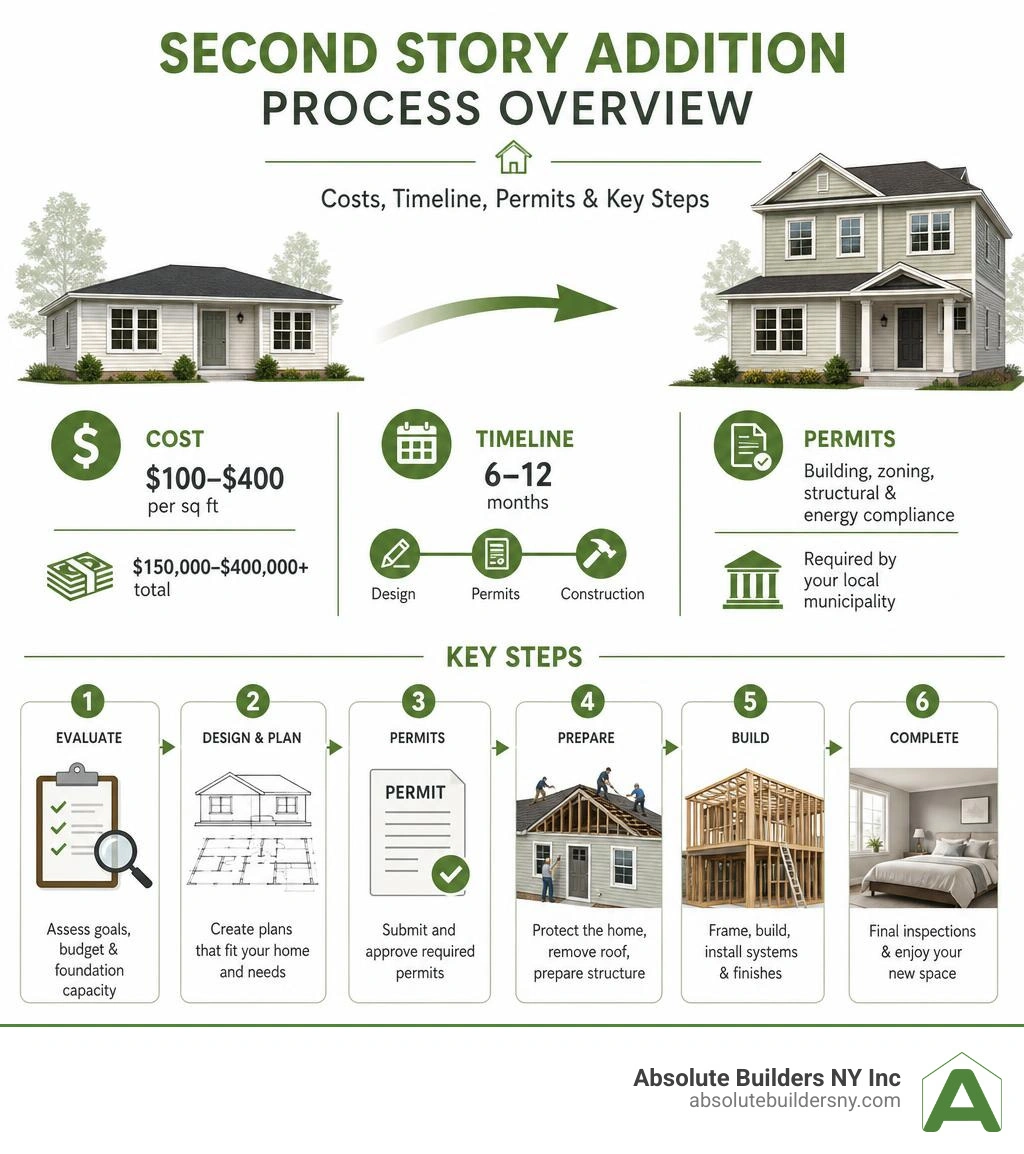
| Average cost | $100–$400 per sq ft; $150,000–$400,000+ total |
| Timeline | 6–12 months (design, permits, and construction) |
| Home value increase | 15–50% depending on location and build quality |
| ROI at resale | 65–75% typical; up to 85–90% in land-scarce markets |
| Foundation check | Required — a structural engineer must assess load capacity |
| Permits needed | Yes — building, zoning, structural, and energy compliance |
| Temporary housing | Often needed for 4–8 weeks during roof removal and framing |
But knowing the numbers is only part of the picture.
The real decision is more personal. Can your home's foundation handle the weight? What permits does your Long Island town require? And is building up actually smarter than moving?
Those aren't simple questions — and the wrong answers can cost tens of thousands of dollars.
This guide walks you through everything: costs, structural requirements, design options, permits, and what to expect during construction. Whether you're dreaming of a master suite above the garage or a full second floor over your ranch home, you'll find clear, honest answers here.
I'm Jacolyn Gleason, a communications professional with deep experience translating complex home construction topics — including adding a second story to your house — into clear, actionable guidance for homeowners. I'll help you cut through the noise so you can make the right call for your home and family.
Adding a second story to your house word roundup:
The Pros and Cons of Adding a Second Story to Your House

Expanding your home vertically is an exciting venture, but it is also one of the most complex residential construction projects you can undertake in 2026. Weighing the benefits against the challenges will help you determine if this path aligns with your lifestyle and financial goals.
The Advantages of Building Up
- Preserving Your Outdoor Space: Unlike a ground-level extension that eats up your backyard, building vertically preserves your lawn, patio, and landscaping. This is especially crucial on tight Long Island lots where yard space is at a premium.
- Substantial Property Value Increase: A well-executed vertical addition can boost your home's market value by 15% to 50%. In competitive local markets, transforming a single-story ranch into a spacious two-story colonial places your property into an entirely different, higher-value buyer pool.
- Enhanced Curb Appeal and Views: Elevating your roofline completely transforms your home’s architectural presence. Plus, a second story often rewards you with better natural light, fresh breezes, and improved neighborhood views.
- Improved Energy Efficiency: Modern building materials and advanced insulation techniques allow us to construct highly efficient upper levels. By utilizing smart zoning and high-performance envelopes, you can actually optimize your home’s overall thermal performance. To learn more about how sustainable construction saves you money, check out our guide on The Benefits of Building an Energy Efficient Home.
The Disadvantages to Consider
- Significant Financial Investment: Vertical construction requires specialized engineering, framing, and safety measures, making it more expensive per square foot than standard ground-level expansions.
- Living Disruption: Because the existing roof must be removed, you will face a period where your home is exposed to the elements, meaning you will likely need to arrange temporary housing.
- Structural and Zoning Hurdles: Not every house is legally or structurally cleared to support a second floor. If your foundation requires heavy reinforcement, your budget can escalate quickly.
Structural Feasibility: Can Your Foundation Support Adding a Second Story to Your House?
Before you pick out paint colors or buy second-floor furniture, you must answer the most critical question of all: Can your existing home actually hold the weight?
When adding a second story to your house, every single pound of the new level—including the framing, drywall, furniture, and future occupants—must safely transfer down to the earth. To ensure your home doesn't suffer structural failure, a licensed structural engineer must perform a comprehensive structural feasibility assessment.
During this inspection, the engineer will evaluate:
- The Foundation: They will check the thickness of your concrete slab, the width and depth of your footings, and soil stability. If your home was built before 1960, the foundation may require underpinning (deepening or widening the concrete footings) or grout injection to increase load capacity.
- Load-Bearing Walls: The engineer will determine if your first-floor walls can act as structural supports or if we need to install structural steel columns and beams.
- Lateral Load Path (Wind Resistance): On Long Island, high coastal winds are a serious design factor. Your home must be retrofitted with plywood shear panels and structural hold-downs to tie the new second story securely to the foundation.
To understand the exact mechanics of how a home is prepped and engineered for vertical loading, review the structural step-by-step in How to Add Second Floor to Your House - This Old House.
Zoning and Permits for Adding a Second Story to Your House
Navigating the local regulatory landscape is often the most time-consuming phase of a home expansion. On Long Island, building departments in Nassau and Suffolk Counties—including towns like Huntington and Babylon—have strict guidelines that dictate what you can and cannot build.
To legally add a second floor, your project must comply with several regulatory layers:
- Zoning Laws and Height Restrictions: Most residential zones have maximum height limits (often 30 to 35 feet) and strict floor-area-ratio (FAR) caps. If your proposed design exceeds these limits, you will need to apply for a zoning variance, which involves public hearings and can add months to your timeline.
- Setback Rules: Even though you are building upward, vertical additions cannot encroach on required front, side, or rear yard setbacks.
- Building Permits: You will need a comprehensive building permit package that includes architectural blueprints, structural engineering calculations, electrical permits, plumbing permits, and energy compliance documentation (such as NYS REScheck calculations).
Failing to secure the proper permits can result in costly stop-work orders, steep fines, or even a legal mandate to tear down unauthorized construction. Working with a team that has deep roots in local municipal processes is essential. Discover how we navigate these localized challenges by reading about our approach to Residential Construction Long Island.
Cost Breakdown and Design Options for Vertical Expansion
The cost of adding a second story to your house varies depending on the size of the footprint, the complexity of your roofline, and the structural upgrades required. On average, you can expect to invest between $100 and $400+ per square foot.
To help you visualize the financial scope of your project, we’ve put together a comparative breakdown of the primary vertical addition configurations:
| Project Type | Average Cost Range | Key Structural Requirements | Best Suited For |
|---|---|---|---|
| Full Second Story (800–1,200+ sq ft) | $175,000 – $400,000+ | Foundation reinforcement, complete roof removal, engineered shear walls | Expanding a small ranch into a classic, multi-bedroom colonial. |
| Partial Second Story (400–800 sq ft) | $80,000 – $200,000 | Targeted structural column insertion, localized roof modifications | Adding a dedicated primary master suite or home office over a garage or wing. |
| Dormer Addition (Variable) | $80,000 – $150,000 | Sistering existing ceiling joists, minor localized framing | Maximizing headroom and natural light in an existing attic or Cape Cod style home. |
To dive deeper into component-by-component cost estimates, including framing, finishes, and mechanical systems, consult the comprehensive Second Story Addition Cost Guide - Builds and Buys.
Full vs. Partial Second Story Additions
When planning your vertical expansion, you must decide whether to build over the entire footprint of your home or just a portion of it.
Full Second-Story Additions
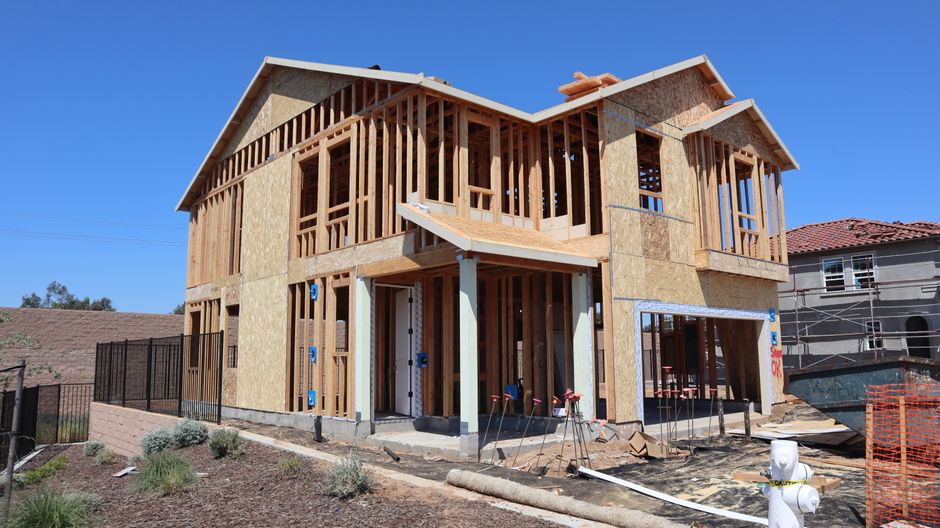
A full addition completely replaces your existing roof with a brand-new second level. This approach is highly popular for transforming single-story ranch homes. It allows for complete layout optimization, letting you place all bedrooms and multiple bathrooms upstairs while converting your entire first floor into an open-concept living space.
Partial Second-Story Additions
A partial addition focuses on a specific section of the house—such as building over an attached garage or adding a single wing. This is an excellent, cost-effective option if you only need one or two extra rooms.
The Staircase Factor: Both full and partial additions require a staircase to access the new level. A standard staircase consumes 80 to 120 square feet of your existing first-floor living space. Strategic placement is critical to maintaining a natural traffic flow downstairs. Learn how to draft floor plans that account for these transitions in our Home Addition Plans Guide 2026.
Dormer Additions and Pop-Tops
If a full vertical addition feels too massive for your current goals, dormer additions offer an incredibly elegant, highly functional alternative. This is particularly true on Long Island, where Cape Cod and split-level homes are incredibly common.
A dormer is a structural protrusion that juts out from an existing sloped roof, complete with its own mini-roof and windows. Adding dormers allows you to:
- Drastically increase headroom in an underutilized attic space.
- Flood your upper level with natural light and fresh air.
- Avoid the expense of complete roof demolition by surgically modifying the existing roofline.
Whether you choose a classic gable dormer, a wide shed dormer, or a modern flat-roof dormer, this option adds immense architectural interest to your exterior while expanding your living space. Explore creative layout ideas and structural tips for these upgrades in our guide: Make Some Home Addition Plans for That Ultimate Upgrade.
Navigating the Construction Process and Living Logistics
Understanding the step-by-step timeline of a vertical addition can help demystify the process and alleviate stress. A typical project proceeds through these core phases:
[Design & Engineering] ──> [Permitting & Approvals] ──> [Site Prep & Demo] ──> [Framing & Utilities] ──> [Finishes & Inspection] (2-3 Months) (1-3 Months) (1-2 Weeks) (2-3 Months) (1-2 Months)- Site Prep & Temporary Roof Removal: The most dramatic phase. The old roof is cut away, and the home is briefly exposed. We utilize industrial-strength tarping systems to protect your first floor from unexpected weather.
- Framing and Enclosure: The new walls, subfloors, and roof trusses are rapidly constructed to make the home watertight as quickly as possible.
- Utility Integration:
- Plumbing Stacking: To save $5,000 to $10,000, we design second-floor bathrooms to stack directly over existing first-floor kitchens or bathrooms, minimizing the need for complex pipe routing.
- HVAC Extension: Rather than overtaxing your old heating and cooling system, we often recommend installing an independent, highly efficient ductless mini-split system for the new second floor to provide zoned climate control.
Choosing Your Professional Team
Because vertical expansions involve high-stakes structural engineering and complex municipal approvals, hiring the right team is paramount.
You have two primary paths:
- The Traditional Route: Hiring an independent architect to draw up plans, and then bidding those plans out to various general contractors.
- The Design-Build Route: Working with a unified team that handles both the architectural design and the physical construction under one roof. This approach reduces miscommunications, keeps your budget aligned with real-world material costs, and streamlines the permitting process.
When vetting professionals, always ask to see local portfolios of completed vertical additions and verify their active licensing and insurance in Nassau and Suffolk Counties. To see what a dedicated, professional partnership looks like from start to finish, explore our services in New Home Construction.
Managing Disruption and Temporary Housing
We always strive to keep our clients fully informed about the realities of living through a major remodel. While it is technically possible to remain in your home during some phases of construction, we highly recommend moving out temporarily during the core construction window (typically 4 to 8 weeks).
During the roof removal and framing phases:
- Your home will have no roof, exposing it to potential weather risks.
- Utilities (water, electricity, gas) will be turned off periodically as systems are extended upward.
- The site will be incredibly noisy, dusty, and busy, presenting safety hazards for children and pets.
When planning your budget, be sure to set aside a temporary housing fund ($3,000 to $8,000 per month depending on your location) so your family can live comfortably and stress-free nearby while our crews safely transform your home.
Frequently Asked Questions about Vertical Additions
How long does a second-story addition take?
The entire process, from your initial design consultation to the final paint touch-ups, typically takes 6 to 12 months. The design and engineering phase takes 2 to 3 months, local Long Island permitting can take 1 to 3 months, and the active, hands-on construction phase generally spans 4 to 6 months.
Can you live in your home during construction?
We strongly advise against it during the heavy structural phases. Once the roof is removed, the home is highly active, noisy, and temporarily lacks climate control and consistent utility access. Moving out for 4 to 8 weeks ensures your family's safety and comfort while allowing our construction crews to work at maximum efficiency.
Is it cheaper to build up or build out?
Per square foot, building out (a ground-level addition) is usually 15% to 25% cheaper because it avoids the costs of temporary roof removal, heavy structural reinforcement, and staircase construction. However, if you live in a land-scarce area where property values are high, or if your local zoning setbacks prevent horizontal expansion, building up is often the only viable—and ultimately most profitable—way to increase your square footage.
Conclusion
Adding a second story to your house is a significant undertaking, but when executed with precision craftsmanship and dedicated partnership, it is one of the most rewarding ways to transform your living space.
At Absolute Builders NY Inc, we specialize in dormer additions, structural framing, and complete home transformations across Long Island. From Nassau County to Suffolk County, including Huntington and West Babylon, we guide you through every step of the journey—handling the engineering, securing the town permits, and delivering beautiful, structurally sound spaces that stand the test of time.
Ready to explore what's possible for your home? Schedule a Home Addition Consultation with our expert team today, and let's start planning your vertical expansion.