
Long Island In-Law Suites and What They Mean for Your Property Resale Value
What an In-Law Suite Could Mean for Your Long Island Home's Value
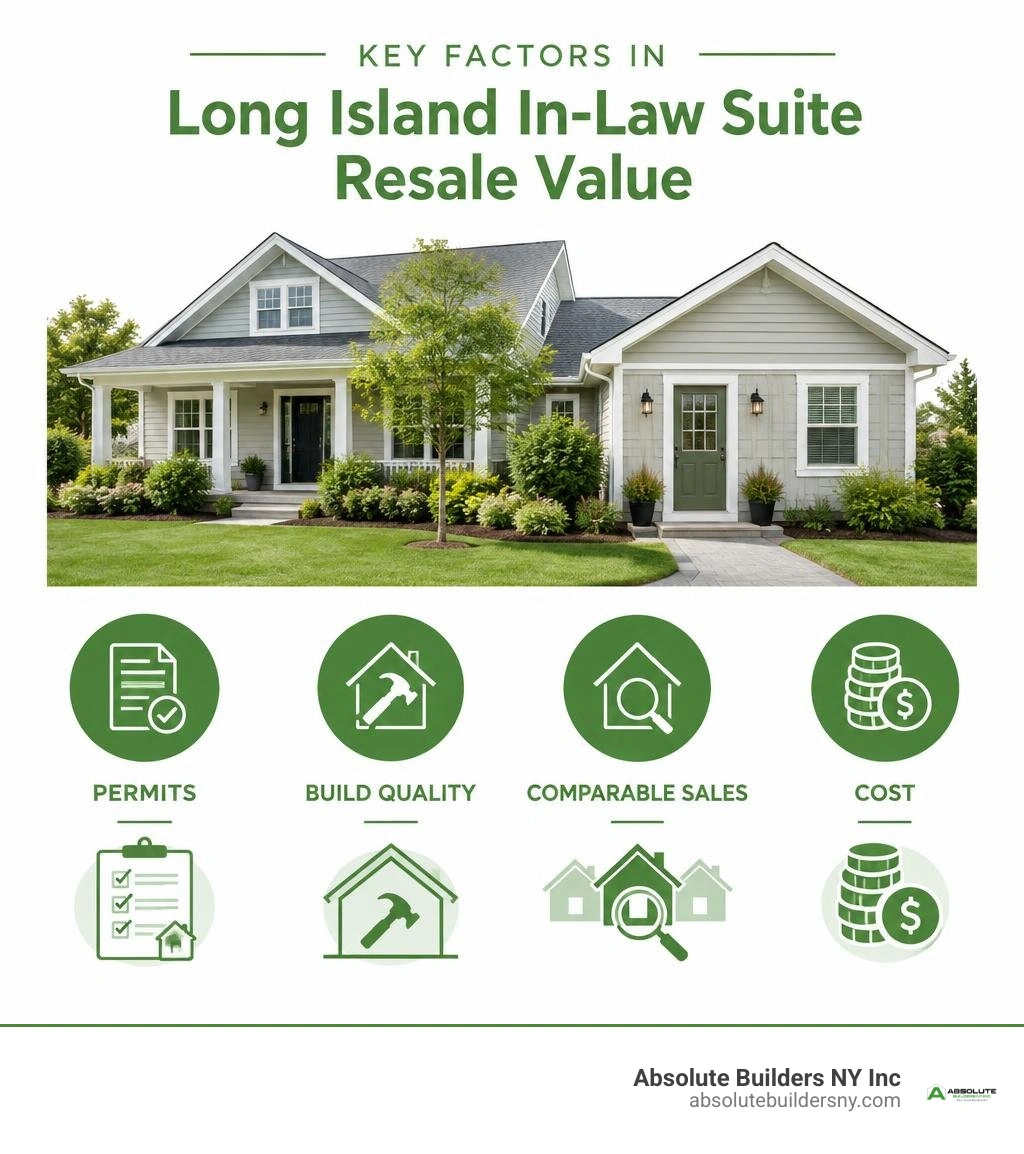
A legal, well-built in-law suite can make a Long Island home more appealing to buyers, but it does not guarantee a set resale premium. Its value depends on the town's rules, approved living space, the quality of the work, and recent sales of similar homes nearby. An unpermitted suite may add little appraised value and can create problems at closing.
If you are thinking about adding space, check what your town will permit before you settle on a design or budget. Then compare the likely build cost with local sale prices. The extra room may be worth it for your family even if you do not recover every dollar when you sell.
I'm Jacolyn Gleason, a public relations professional with experience making complex consumer and lifestyle topics easier to understand. In this guide to the value of a mother suite on Long Island, I'll walk through the questions homeowners should ask about legal status, costs, and resale.
Long Island mother suite value helpful reading:
- Long Island in law addition cost
- small mother in law suite floor plans
- Huntington in law addition ideas
Legal Definitions and Zoning: Mother-in-Law Suites vs. ADUs on Long Island
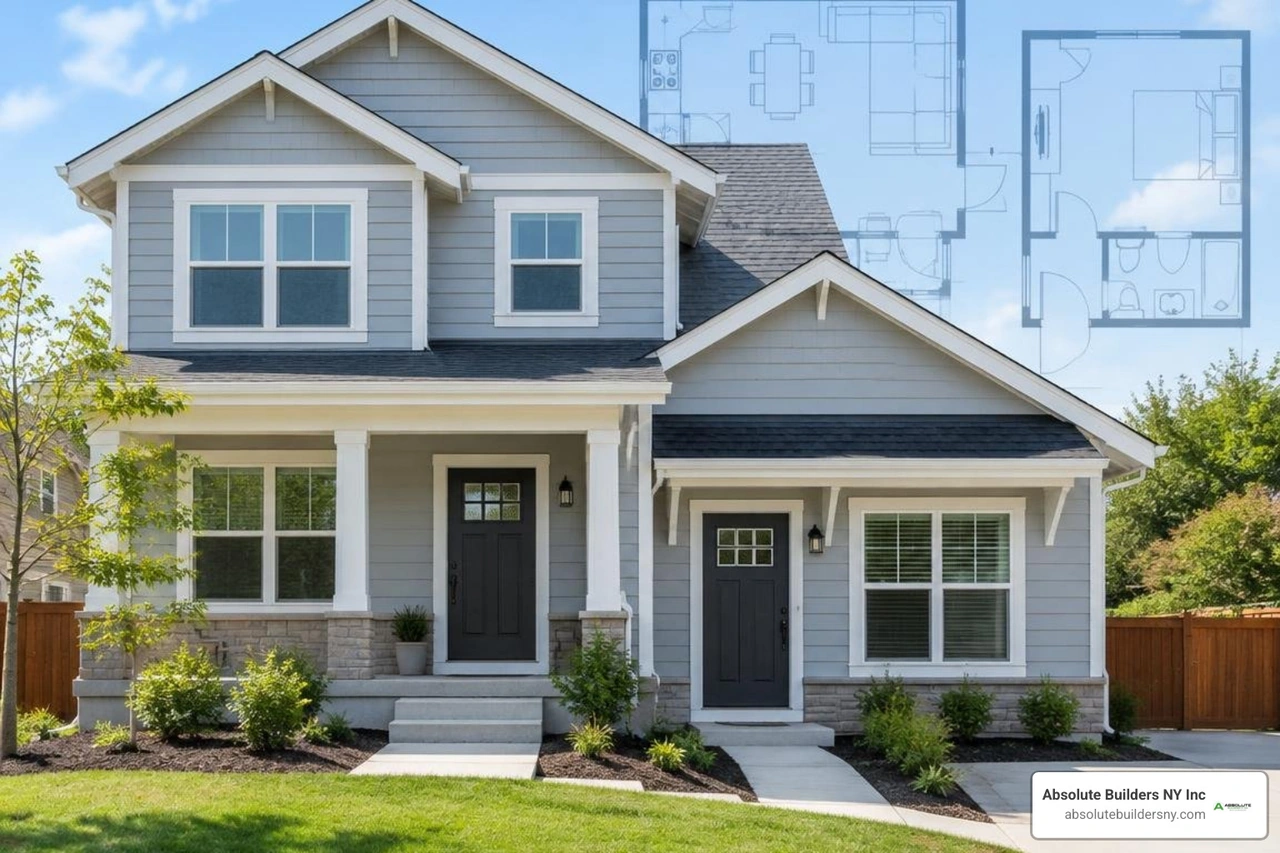
When planning a suite on Long Island, the first hurdle is rarely the floor plan—it is the town code. New York real estate terminology often uses terms like "mother-daughter," "in-law suite," and "accessory dwelling unit" (ADU) interchangeably, but municipal building departments in Nassau and Suffolk County draw sharp distinctions between them.
A traditional mother-in-law suite (or mother-daughter setup) is an interconnected secondary living area within a single-family dwelling. Under most local codes, it is permitted solely for immediate family members related by blood, marriage, or legal adoption. It shares a single Certificate of Occupancy (C of O), retains interior access to the rest of the house, and cannot be rented out to the general public as an independent apartment.
An Accessory Dwelling Unit (ADU) or legal accessory apartment, by contrast, is an independent living unit with its own dedicated exterior entrance, complete kitchen facilities, and separate utility or egress approvals. In townships that permit accessory apartments, they may be rented to non-family tenants, but they require specific special-use permits and strict owner-occupancy covenants.
An illegal conversion occurs when a homeowner installs full secondary cooking facilities (specifically a 220V stove line or gas range), closes off required interior doorways, or converts a basement without building permits, egress windows, or an updated Certificate of Occupancy.
| Feature | Mother-in-Law / Mother-Daughter Suite | Legal Accessory Dwelling Unit (ADU) | Illegal Conversion |
|---|---|---|---|
| Zoning Classification | Single-Family Residence | Single-Family with Accessory Permit | Single-Family (Violated) |
| Occupancy Rule | Immediate family members only | Family or non-family tenant | Unregulated / Non-compliant |
| Kitchen Type | Secondary prep area or conditional kitchen | Full independent kitchen | Unpermitted full kitchen |
| Interior Access | Must maintain connecting door to main home | Independent / May be separated | Often permanently blocked |
| Certificate of Occupancy | Single C of O with conditional permit | Single C of O with Accessory Endorsement | Outdated C of O (Building Violation) |
| Resale Impact | Adds legitimate value and buyer interest | Adds quantifiable income-based value | Creates title hurdles and escrow delays |
Understanding local municipal rules, such as the Town of Hempstead Mother-Daughter Use regulations, ensures your renovation is fully protected from future municipal enforcement.
Understanding Long Island Mother Suite Value Through Legal Compliance
The appraised value of your secondary suite hinges entirely on what is written on your town-issued Certificate of Occupancy. Appraisers cannot assign full gross living area (GLA) value to unpermitted space. When an addition is completed with approved plans and closed municipal permits, the extra bedroom, living room, and bathroom are evaluated as legal above-grade square footage.
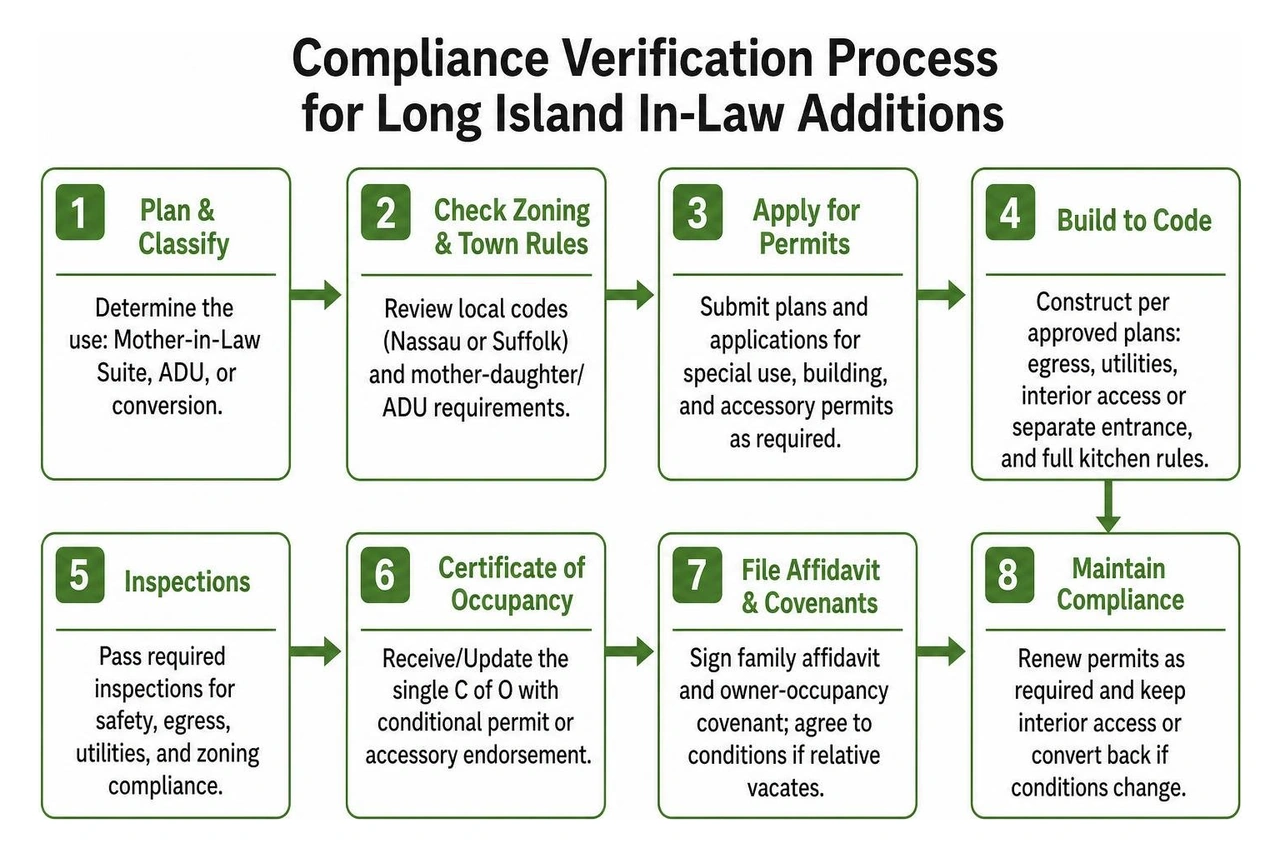
Maintaining single C of O compliance also prevents deed complications. Many townships require homeowners to sign an affidavit or record a covenant stating that if the elderly parent or relative vacates the home, the secondary kitchen fixtures must be disconnected or the home returned to standard single-family use. To learn more about navigating these layouts, explore our guide to homes with mother-in-law suites.
Nassau vs. Suffolk County Permit Rules and Mother-Daughter Ordinances
Permit requirements vary significantly across Long Island's towns:
- Town of Hempstead (Nassau County): Requires a special mother-daughter permit. The property must be owner-occupied, the secondary kitchen requires specific zoning board approval, and the permit must be renewed periodically with an updated family affidavit.
- Town of Oyster Bay (Nassau County): Distinguishes parent-child residences with strict architectural rules, requiring the home to maintain the exterior aesthetic of a standard single-family home.
- Town of Babylon (Suffolk County): Operates an active accessory apartment program where accessory units may be legalized under specific lot-size rules, provided adequate off-street parking is paved and available.
- Town of Huntington (Suffolk County): Enforces dedicated accessory apartment and family suite ordinances that require architectural plan reviews, board approval, and proof of septic or sewer capacity before building permits are issued.
In unsewered areas across eastern Nassau and Suffolk County (such as Westhampton or Bayville), expanding your home’s bedroom count often triggers Suffolk County Department of Health Services review to verify that your septic tank and leaching fields can handle the additional plumbing load.
How an In-Law Suite Impacts Long Island Mother Suite Value and Resale Pricing
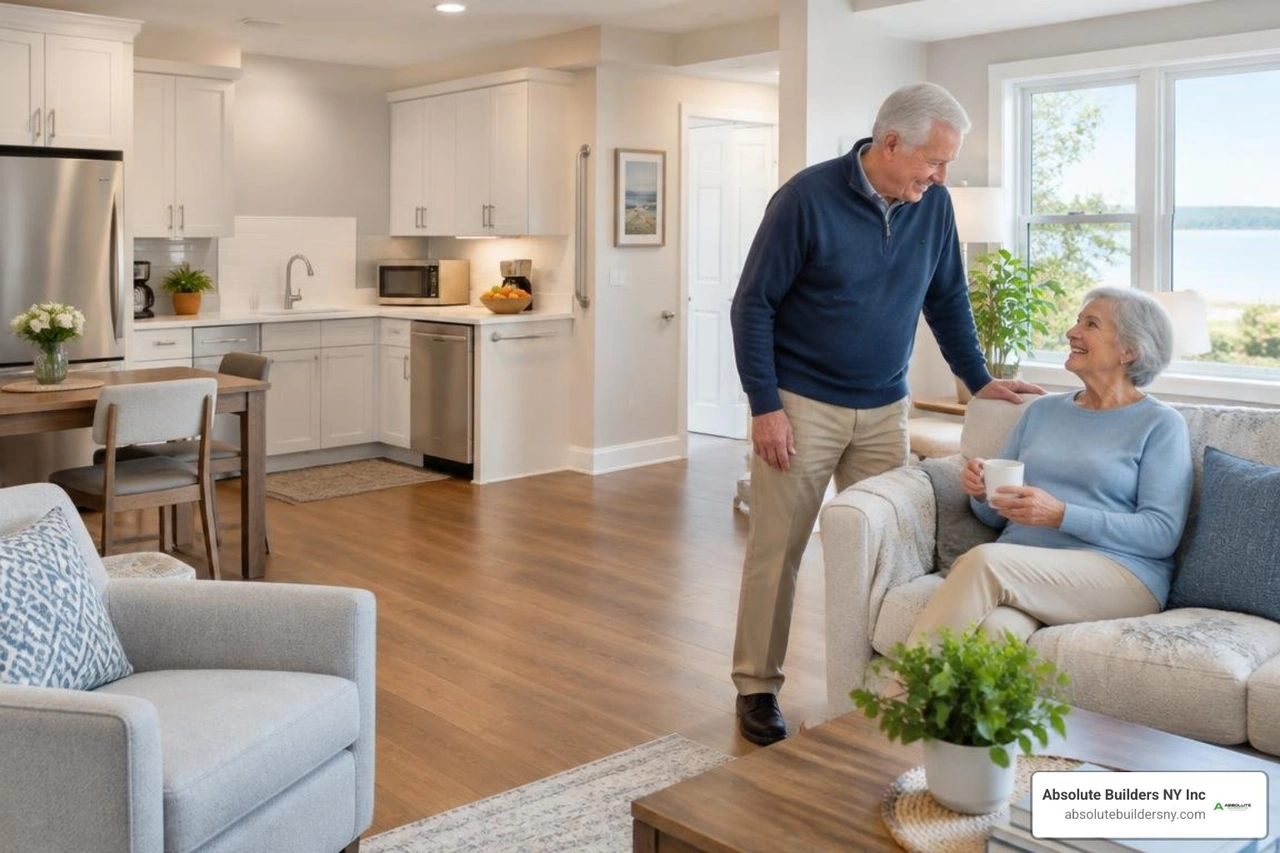
In the Long Island real estate market, properties that accommodate extended family are in high demand. Evaluating recent sales across Nassau and Suffolk counties reveals that legal in-law suites provide a noticeable competitive edge.
For example, a legal mother-daughter residence on Bernice Road in Franklin Square sold for $900,000, underscoring the strong buyer interest in homes that offer legal secondary living quarters in Nassau County's competitive school districts. When properties feature high-end architectural finishes, the valuation lift is even more pronounced—as seen in broader regional markets where master-crafted, distinctive home upgrades justify premium valuations, detailed in luxury architectural craftsmanship data.
Resale Premiums, Appraisal Adjustments, and Days on Market
Documented transaction data reveals three consistent market trends for properties with permitted in-law suites:
- Measurable Resale Premiums: Single-family homes with fully permitted, above-grade in-law suites command sale premiums between $40,000 and $120,000 over comparable single-family homes lacking multigenerational space.
- Accelerated Market Velocity: Listings featuring verified in-law suites spend roughly 22% fewer days on market compared to standard single-family layouts.
- Appraisal Mechanics: Appraisers treat legal, permitted ground-floor additions as full gross living area. However, basement suites—even with egress windows—are adjusted on a below-grade basis, which yields a lower dollar-per-square-foot valuation than above-grade extensions.
Data from the National Association of Realtors indicates that 20% of active buyers are willing to pay a direct premium for a home featuring an established mother-in-law suite.
Multigenerational Living Demand Driving Long Island Buyer Search Trends
Market studies indicate that 41% of Americans shopping for a home are evaluating properties capable of accommodating an aging parent or an adult child returning home.
On Long Island, where property taxes, childcare costs, and independent assisted-living facilities can place immense financial strain on families, pooling household resources is a practical strategy. A private suite with a bedroom, accessible bathroom, and sitting room allows elderly parents to age in place safely while saving thousands of dollars per month in private eldercare costs. When families do not require housing for relatives, these spaces transition into private guest suites or quiet home offices.
Construction and Conversion Costs Across Long Island Suite Styles
Building a mother-in-law suite requires balancing your family's functional needs with long-term return on investment. The cost depends largely on whether you build outward, build upward, or convert existing square footage.
| Suite Style | Typical Size | Long Island Cost Range | Typical Timeline | Expected Equity Return |
|---|---|---|---|---|
| Attached Ground-Floor Addition | 450 – 800 sq ft | $180,000 – $320,000 | 4 – 6 Months | High (100% Above-Grade GLA) |
| Basement Suite Conversion | 500 – 900 sq ft | $90,000 – $200,000 | 2 – 4 Months | Moderate (Below-Grade GLA Limits) |
| Second-Story Dormer Extension | 500 – 850 sq ft | $160,000 – $280,000 | 3 – 5 Months | High (Maximizes Lot Coverage) |
| Detached Cottage / ADU | 400 – 750 sq ft | $220,000 – $450,000+ | 6 – 9 Months | Moderate (Subject to Zoning) |
How Build Style Impacts Long Island Mother Suite Value
Ground-level attached wings and dormered additions deliver the highest appraisal value on Long Island because they add verified above-grade living area. For a complete look at budget considerations, review our long-term in-law addition cost breakdown or read our guide on building a custom in-law suite addition.
Basement conversions offer a lower initial construction cost, but they require egress window wells, specialized waterproofing, sub-slab plumbing tie-ins, and mandatory minimum ceiling clearances under the New York State Residential Code.
Financing Renovation Projects: FHA 203(k), HELOCs, and HomeStyle Loans
Homeowners have several financing routes to fund suite construction:
- FHA 203(k) Renovation Loans: Allows home purchasers or refinancing owners to roll the purchase price and construction costs into a single mortgage based on the projected future value of the completed home.
- Fannie Mae HomeStyle and Freddie Mac CHOICERenovation: Conventional renovation loans that provide competitive interest rates for building permitted additions.
- Home Equity Lines of Credit (HELOC): A flexible borrowing option for Long Island homeowners with substantial existing equity who want to fund construction phases as milestones are completed.
For step-by-step guidance on structuring your project, consult our guide on adding a mother-in-law suite to your house.
The Illegal Conversion Trap: Due Diligence, Disclosures, and Legalization
One of the costliest mistakes a Long Island homeowner can make is creating an unpermitted apartment and attempting to market it as a "bonus income unit."
Municipalities across Nassau and Suffolk aggressively enforce single-family zoning codes. If a neighbor complains or a building inspector spots unpermitted exterior stairs or secondary gas lines, the town can issue stop-work orders, summonses, and daily fines. In severe cases, the town may issue an immediate vacate order.
NY Property Condition Disclosures, Town Fines, and Vacate Orders
Under New York State’s updated Property Condition Disclosure Act, sellers must complete comprehensive disclosure forms regarding unpermitted work, open building violations, and unapproved kitchen installations. Failing to disclose unpermitted construction exposes the seller to post-closing lawsuits.
Furthermore, bank underwriters routinely flag unpermitted second kitchens. If an appraiser notes a full range in a basement or secondary wing without an accompanying C of O, the lender may refuse to issue mortgage clearance until the cooking appliances are removed, gas lines capped, and the space reinspected.
Buyer Due Diligence Checklist for Homes with Existing In-Law Suites
When buying a home with an existing suite in communities like Huntington, Massapequa, or West Babylon, complete this checklist before signing your contract:
- Order an Official Municipal Search: Request a complete building department file from the local town hall to review all original Certificates of Occupancy and past permits.
- Cross-Check Blueprints Against Physical Layout: Verify that the existing walls, bathrooms, and exterior doors match the stamped architectural plans on file with the town.
- Verify Kitchen Approvals: Check whether the secondary cooking area has an active, transferrable special-use permit or if it was installed without plumbing and electrical filings.
- Inspect Fire Separation and Egress: Ensure the suite features code-compliant smoke/carbon monoxide detectors, adequate egress windows in all sleeping quarters, and proper fire-rated sheetrock between living zones.
- Consult a Licensed Contractor: Partner with a construction professional to assess whether unpermitted spaces can be legalized or if bringing them up to code will require structural modifications. Learn more about working with us on full-service home addition planning.
Mother-In-Law Suite Legal Status and Property Classification
A permitted in-law suite preserves your home's legal standing while adding functional living space. Here is how permitted and unpermitted spaces compare across key property classifications:
| Evaluation Factor | Permitted Legal In-Law Suite | Unpermitted Conversion |
|---|---|---|
| Title Clearance | Clean title transfer; no municipal holds | Potential escrow holds or closing delays |
| Mortgage Underwriting | Approved under standard single-family guidelines | Lenders may mandate stove removal before funding |
| Insurance Coverage | Fully covered under standard homeowner policy | Claims in unpermitted spaces may be denied |
| Property Tax Assessment | Assessed accurately based on approved square footage | Subject to retroactive reassessment and penalties |
| Rental Flexibility | Legal for family occupancy (or tenants if zoned ADU) | Non-compliant; exposes owner to tenant lawsuits |
Frequently Asked Questions About Long Island Mother-in-Law Suites
Does a legal mother-in-law suite increase property taxes on Long Island?
Yes, building an addition will trigger an adjustment in your property's assessed value because you are increasing the usable square footage and bathroom count. However, your taxes are reassessed only on the value of the new improvements—not on the entire home from scratch. Homeowners can also explore local home improvement tax phase-in exemptions where available.
Can an unpermitted in-law suite hold up a home closing in Nassau or Suffolk?
Yes. Title companies and bank appraisers closely review the Certificate of Occupancy against the physical property. If an unpermitted kitchen or converted garage is discovered, the buyer's lender will often condition the mortgage on removing the stove, capping lines, and passing a municipal inspection before closing.
Can you rent out a mother-in-law suite on Long Island to a non-family member?
In most Nassau and Suffolk single-family zones, standard mother-daughter permits strictly require the occupant to be a direct family member. Renting to an unrelated tenant requires your home to be located in a township or zoning district that explicitly permits accessory apartments, and you must hold an active accessory rental license.
Conclusion
Adding a mother-in-law suite to your Long Island home offers practical everyday benefits for multigenerational living while creating long-term property equity. However, realizing the true return on your investment requires following local building codes, securing town permits, and maintaining architectural harmony.
At Absolute Builders NY Inc, we bring precision craftsmanship and dedicated partnership to every residential project across Nassau and Suffolk County. Whether you are adding a first-floor ground addition, building a second-story dormer extension, or designing an accessible living space for a parent, our team manages the entire process from architectural planning to final permit sign-offs.
Ready to explore your options? Discover our custom mother-in-law suite design and build services and let us help you create a beautiful, fully compliant space for your family.